
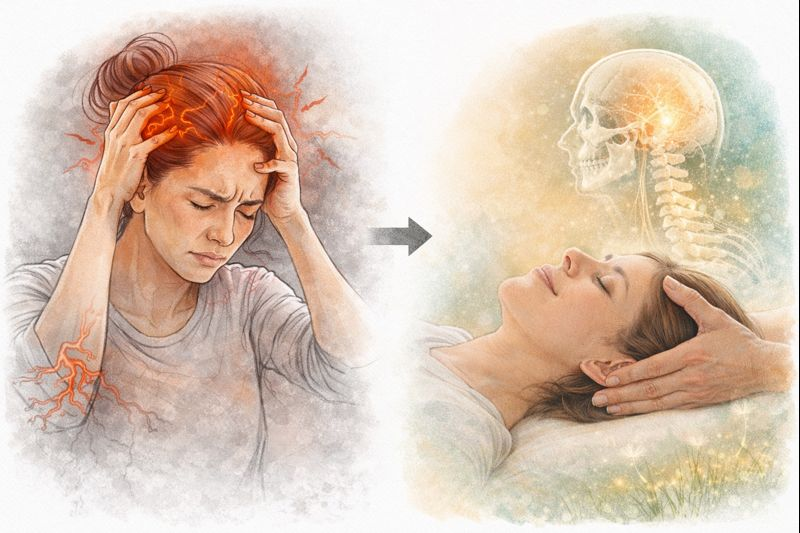
A gentle, nervous-system-centred approach
Craniosacral Therapy for migraine offers a gentle, nervous-system-centred approach for people living with recurrent headaches.
Migraine is not “just a headache.” For many, it is a whole-body experience involving muscles, the nervous system, stress responses, and emotional load.
At Serena CranioCare, I offer Craniosacral Therapy (CST) as a complementary approach. It is gentle, non-invasive, and adapted to each person’s sensitivity and history. While it is not a cure, CST supports the body’s natural capacity to settle, regulate, and find balance.
1. Craniosacral Therapy for Migraine and the Nervous System
Migraine is closely linked to the autonomic nervous system.
Many people live in a state of chronic stress, where the body remains in “fight or flight” for too long.
CST provides a safe, slow, and attentive environment.
Through gentle touch, the nervous system can begin to settle and rebalance.
When the nervous system feels calmer, the body may respond better to triggers. Over time, this can support a reduction in migraine frequency and intensity.
2. Reducing Tension in the Head, Neck, and Body
Many people with migraine carry tension in the neck, shoulders, jaw, and cranial region.
This tension can add to the nervous system’s stress load.
CST works with fascia, muscles, and cranial tissues through very gentle, respectful techniques.
The goal is not to force change, but to allow the body to release restrictions naturally.
Reducing tension in these areas can support the nervous system and may make migraine patterns easier to manage.
3. Supporting How Pain Is Processed
Pain is shaped not only by tissues, but also by how the nervous system interprets signals.
In migraine, pain pathways can become sensitised over time.
Gentle manual therapies engage the body’s natural pain-modulating systems.
Craniosacral Therapy for migraine can support these pathways, helping the body perceive pain differently.
Many people notice that attacks feel less intense or easier to recover from after regular sessions.
4. Stress, Emotional Load, and Regulation
Living with migraine often brings anxiety, frustration, and hyper-vigilance.
These states increase the nervous system’s sensitivity and can trigger attacks.
CST sessions are typically quiet, restorative, and low-stimulus.
In this space, the nervous system can process stress gently.
Some clients experience emotional release or simply a sense of deep calm.
Supporting emotional and nervous system regulation may, over time, positively influence migraine patterns.
A Complementary and Gentle Approach
Craniosacral Therapy is a non-invasive, complementary approach.
It works with the body’s natural ability to regulate and is always adapted to the individual.
Each session respects your sensitivity, history, and nervous system.
If you live with migraine and are curious about a gentle, nervous-system-based approach, you are welcome to reach out.
For extra resources you may also explore Upledger Institute resources .