
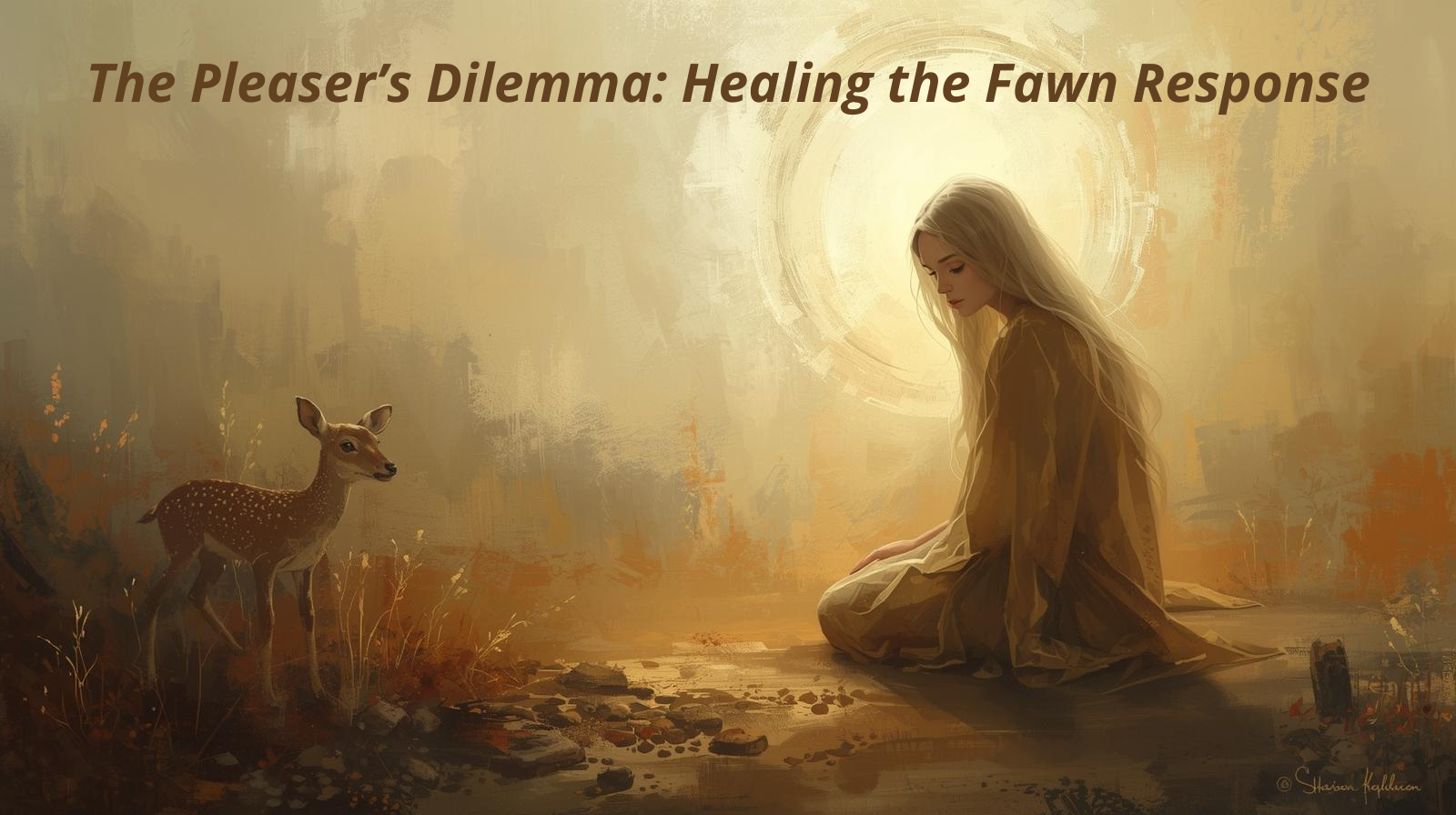
Explore how healing the fawn response and codependency in the body can help you find safety, healthy boundaries, and authentic connection through CranioSacral Therapy.
The Pleaser’s Burden
Many of us learn to stay safe by pleasing others — saying yes, keeping peace, and caring for everyone but ourselves. This is the fawn response, a survival pattern that can eventually lead to codependency and exhaustion.
However, through awareness and gentle support such as CranioSacral Therapy, we can begin to soften these old protections. In this way, we rediscover safety in being authentic and whole again.
The Biology of the Fawn Response
When we feel threatened, our nervous system automatically seeks safety. Most of us know the fight, flight, or freeze responses — but there is also another, more subtle one: the fawn response.
It appears when our survival depends on appeasing others — keeping them calm, happy, or approving so that we can feel safe. Biologically speaking, it is a parasympathetic strategy that arises when fighting or fleeing are not possible.
Moreover, the vagus nerve plays a central role. It softens our voice, our expression, and even our impulses so that we can maintain connection. Inside, though, the body holds tension — shallow breath, tight belly, and a polite smile hiding strain.
Fawning is not weakness. Rather, it is an intelligent survival response, born in environments where love and safety felt conditional.
When Fawning Becomes a Pattern
In childhood, fawning can protect us from emotional unpredictability. Over time, however, when it becomes a habitual pattern, it quietly shapes how we relate as adults.
We might become caretakers, listeners, or peacekeepers — roles that once ensured safety but now drain us. As a result, we may struggle to set boundaries or believe that love can exist without constant giving.
Consequently, this is often where codependency begins. Our sense of worth becomes tied to the wellbeing or approval of others.
On the surface, we appear kind and accommodating. Yet underneath, the nervous system is on alert — scanning for cues of rejection or disapproval. The body, therefore, never truly rests when connection feels like something that must be maintained at all times.
The Core Belief Beneath
At the center of the fawn pattern lies a painful belief:
“My worth depends on how others feel about me.”
“If I meet my own needs, I’ll lose love.”
This belief forms when a child senses that love must be earned through good behavior or emotional attunement. Gradually, the body learns to associate connection with compliance, and authenticity starts to feel dangerous.
Therefore, the heart stays guarded. It whispers, “If I’m honest, I might lose love.”
So we smile, agree, and adapt — even when something inside us aches to be seen as we truly are. Ultimately, healing begins when we recognize this belief as a survival story, not our truth.
Pathways for Healing
Healing begins with safety and self-recognition — learning to feel one’s own sensations, desires, and limits without fear.
To truly heal the fawn response, we must first understand that boundaries and connection can coexist. Safety no longer needs to be bought through self-erasure.
As the body learns to tolerate small doses of healthy disagreement, the autonomic nervous system gradually recalibrates. Consequently, the vagus nerve strengthens its capacity to stay regulated even when tension arises.
In turn, muscles soften, breath deepens, and the body remembers it can be both kind and authentic.
Practices that focus on interoception — the awareness of internal sensations — help rebuild this sense of self. Furthermore, moments of stillness, grounding, or gentle touch invite the body to feel safe without performing.
Little by little, the nervous system learns that safety can coexist with authenticity.
How CranioSacral Therapy Supports This Process
CranioSacral Therapy creates a space of profound neutrality — a relationship where nothing needs to be fixed or earned.
As the therapist listens through touch, the client’s system often begins to trust again. Gradually, muscles soften, breath deepens, and the body remembers: it is safe to be as I am.
As the system settles, the pericardium — the heart’s protective membrane — can soften. In addition, the diaphragm loosens, the vagus nerve balances, and the body remembers the feeling of safety from within.
From this place, giving and receiving become effortless again — not driven by fear, but by genuine connection. Therefore, CranioSacral Therapy invites the pleaser to finally rest, allowing the heart to open in its natural rhythm of giving and receiving love.
An Invitation
If this resonates with you — if you recognize how easily your attention turns toward others’ comfort — know that this pattern can soften.
Whether it shows up as fatigue, tension, or simply a quiet loss of self-connection, your body already knows the way back to balance. And with the right support, you can return to a deeper sense of peace and authenticity. In my CranioSacral Therapy sessions, we listen together to what your system needs to feel safe, supported, and free to be authentic again.